Podcasting guides
July 9, 2026


Podcasting in education is the use of audio recording and publishing to support teaching, assessment, and communication skills – whether that is a student-produced classroom project, a faculty research series, or a department's public-facing show. It has quietly become one of the most effective formats in education. From middle school classrooms to university departments, it gives students a way to develop real communication skills and gives educators a flexible tool for both teaching and assessment.
But here is the problem most schools run into: the technology gets in the way. Setting up microphones, managing cables, troubleshooting interfaces, dealing with memory cards and editing software – it adds up fast. The programs that actually succeed are the ones that remove that friction, so teachers and students can focus on content instead of gear.
This guide covers the benefits of podcasting in education, what real institutions are doing with it, how to start a podcast project in a classroom or university, and what kind of setup actually makes it sustainable.
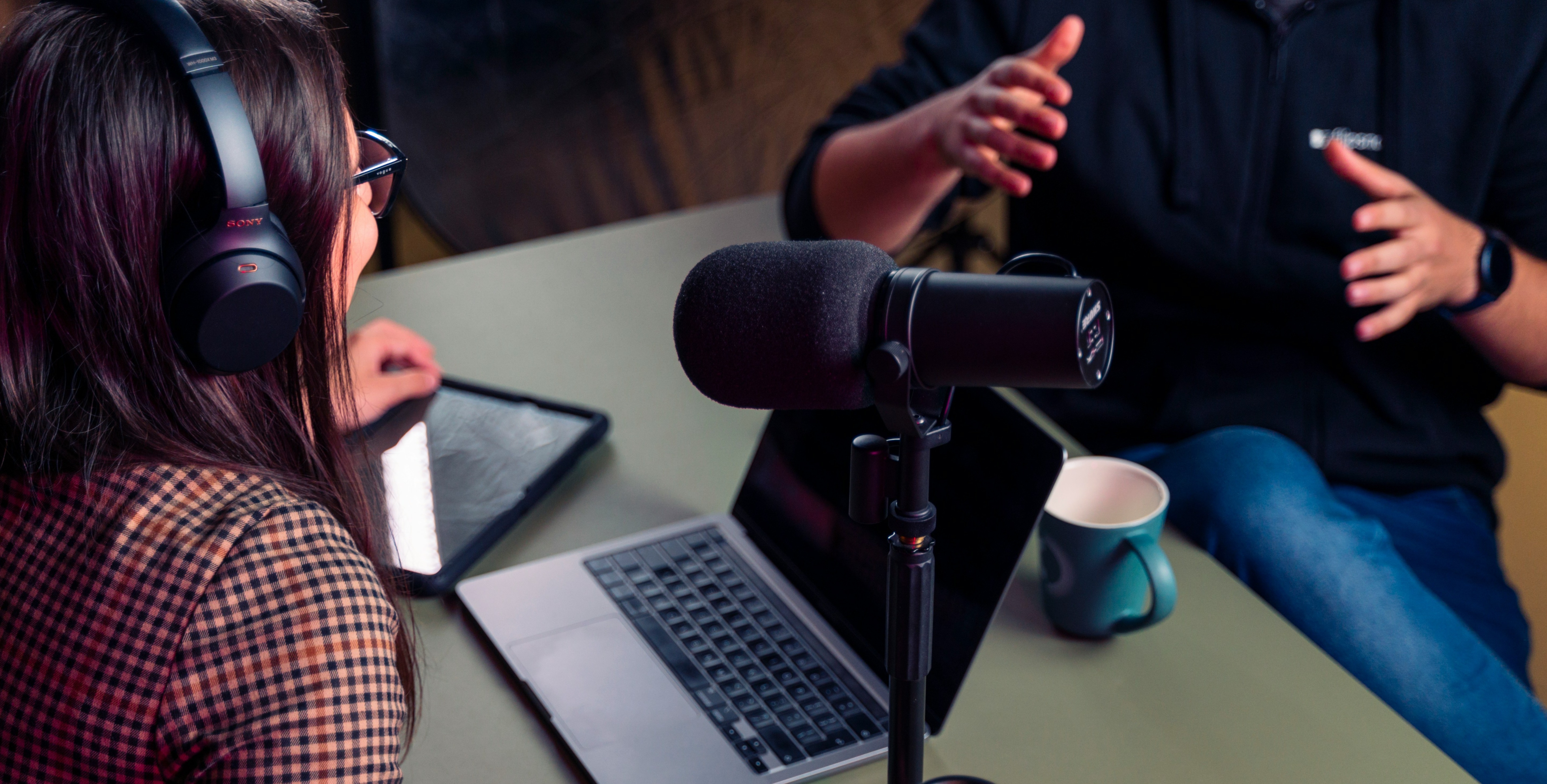
Photo by Flipsnack on Unsplash
The reason podcasting keeps gaining traction in schools is not because it is trendy. It is because the format naturally supports the kinds of learning outcomes that matter most: critical thinking, clear communication, collaboration, and the ability to organize ideas for a real audience.
When students plan, research, script, and record a podcast episode, they are doing something fundamentally different from writing an essay or sitting through a lecture. They have to synthesize information, make editorial choices, speak clearly, and work with others on a shared deliverable. That is active learning by any definition.
Audio also has practical advantages that other formats do not. Students can listen to course content away from a screen, which makes podcasts useful for review, commuting, and asynchronous learning. When paired with transcripts, podcasts become an accessibility tool as well, giving students multiple ways to engage with the same material.
And in 2026, the infrastructure around podcasting has matured significantly. AI-powered transcription is now accurate enough to generate usable show notes, searchable text, and accessibility-ready transcripts with minimal manual cleanup. Cloud-based editing tools have lowered the post-production barrier so that students and faculty can collaborate on episodes without needing to install professional audio software.
Educational podcasting is not theoretical. Institutions across the spectrum are using it in different ways, and the variety of educational podcast formats shows how adaptable the medium really is.
Department research and thought leadership. Stanford Graduate School of Business launched If/Then to give professors a platform for discussing their research. Columbia University's Dead Ideas in Teaching and Learning takes a more pointed approach, with faculty challenging assumptions about how higher education works.
Student-led storytelling. Medical students at the University of Iowa produce The Short Coat Podcast, an unfiltered look at the realities of medical school. At Bowling Green State University, the BG Ideas podcast features interviews with academics, artists, and alumni.
K-12 projects. At Kairos Leadership Academy, middle school students produce The Bean Bag, interviewing teachers, staff, and fellow students about life at the school. At the University of Colorado Colorado Springs, history students replaced a traditional essay assignment with an audio "game show" format to test each other on decades of American history.
Sometimes the podcast host is the visiting guest, not the school. Pam Covarrubias, host of Cafe con Pam, brought a Sound Capsule into a middle school career day and turned it into a live recording session with the students themselves.

"I brought my Sound Capsule to a middle school career day and recorded a mini podcast with the students right there in the classroom. No mic stands, no tangle of cables, no sound tech in the room... Those kids walked out thinking they had made real radio." – Pam Covarrubias, host of Cafe con Pam
Universities like Lancaster, Liverpool, Texas A&M, Arkansas, and Exeter are also actively using podcasting in their programs, across departments ranging from management to journalism to student media.

For K-12 educators, the key is to tie every podcast project to a clear learning objective. Podcasting should not be a novelty assignment – it should be used because it helps students do something better than they could with a written paper or a class presentation alone.
Some formats that work well across age groups and subjects:
The thing that makes a podcast assignment land is that students know someone will actually listen. That shift – from producing for a grade to producing for an audience – is what makes using a podcast as assessment different from most classroom formats.
At the university level, podcasting serves a different set of needs. The audience is broader, the use cases span multiple departments, and the content often has a longer shelf life. A good university podcasting program is not just a classroom tool – it can support research communication, recruitment, alumni engagement, and institutional storytelling.
Some of the most common use cases in higher education:
The operational challenge at universities is different from K-12. It is less about a single teacher managing a classroom project and more about making equipment available across departments, locations, and user groups – often with no dedicated audio staff.
Most school podcasting programs do not fail because of bad pedagogy. They fail because the setup is too complicated for the people who have to run it.
Think about what a traditional podcast workflow looks like: multiple microphones, XLR cables, an audio interface, headphones, a laptop running a DAW, SD cards, gain staging, and then file transfer and editing afterward. That is fine for a dedicated production team. It is not realistic for a teacher who has 30 minutes between classes and no audio background.
The friction shows up in predictable places. Teachers spend too long setting up and troubleshooting. Students lose recording time to technical issues. Files end up scattered across devices. And after one or two painful sessions, the equipment goes back in the closet.
For podcasting to scale in education, the equipment has to work for non-technical users. That means fewer components, faster setup, and a clear path from recording to finished audio without requiring someone to learn professional editing software.
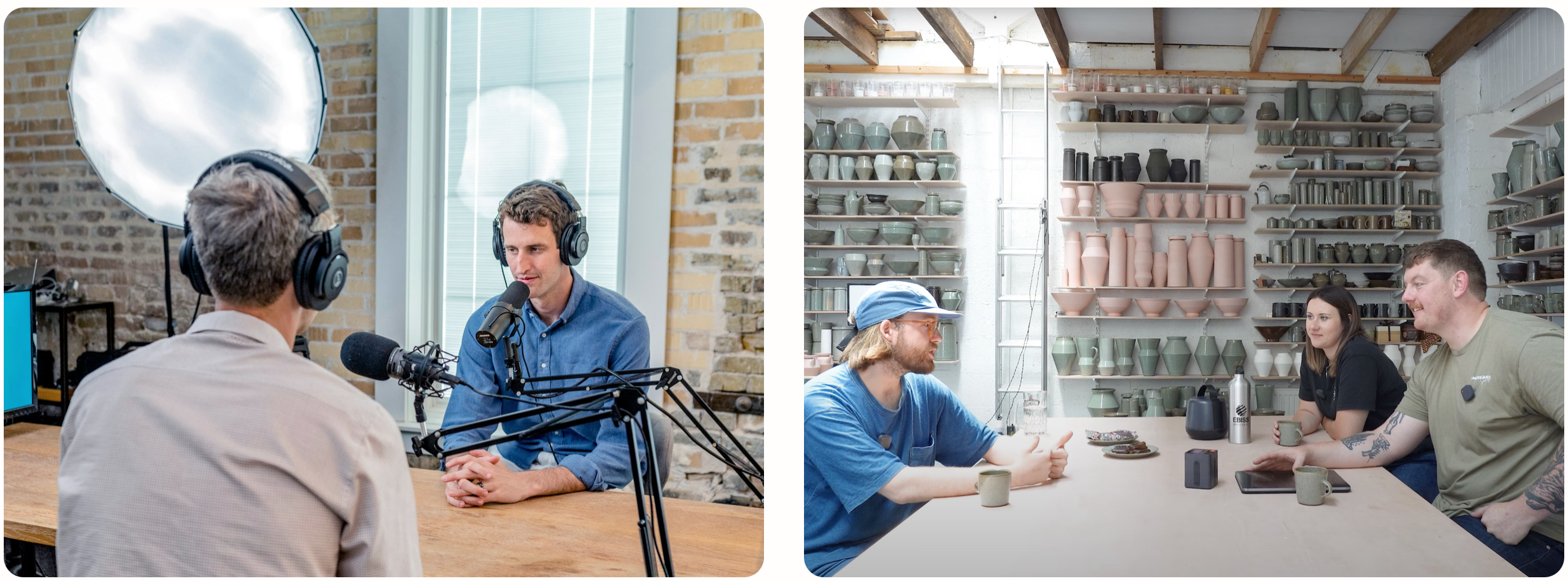
If you are evaluating podcast equipment for a school, department, or university program, the checklist is shorter than you might expect. The goal is not to replicate a professional studio. It is to make recording reliable and repeatable for people whose main job is teaching, not audio production. For a broader look at equipment, see our guide to choosing podcasting equipment.
You need:
The Nomono Sound Capsule was built around exactly this problem. It is a portable, all-in-one recording kit with up to four wireless microphones, a one-button recorder, and a cloud-based workflow that handles upload, storage, AI-powered audio enhancement, transcription, and collaboration.
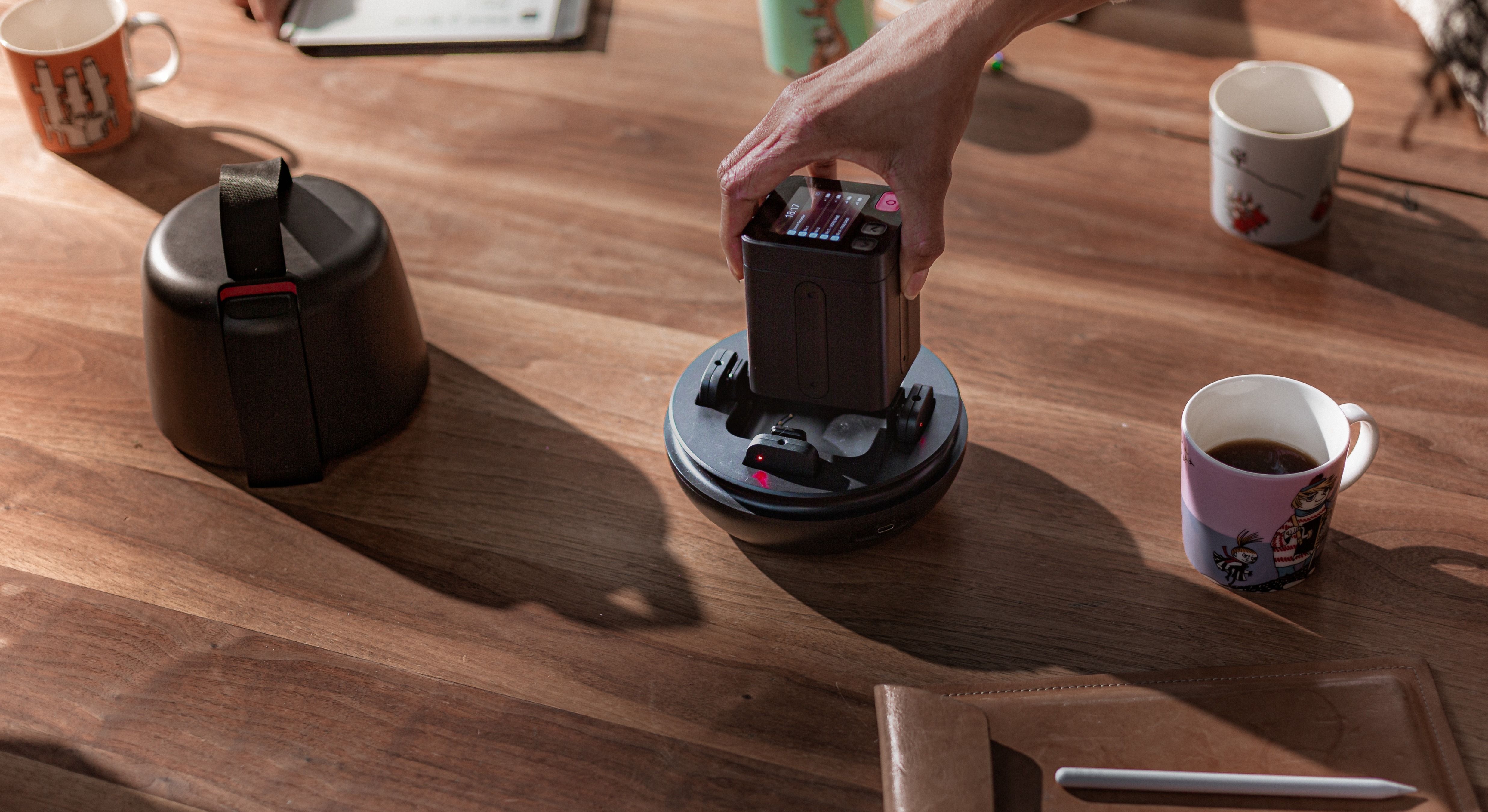
In practice, that means a teacher or student can open the case, clip on the mics, press record, and have broadcast-quality audio uploading to the cloud as soon as they connect to Wi-Fi. No cables, no gain adjustment, no file management. The Sound Capsule weighs under 1.5 kg and fits in a backpack, so it can move between classrooms, campus locations, and field settings without any of the bulk of a traditional recording setup.
"All recordings have come out brilliantly, and more are in the pipeline. The sound quality is always superb – hard to believe it is done on remote mics and not always in a studio." – Paul Turner, Lancaster University Management School
The cloud side matters just as much as the hardware. Nomono Studio lets teams edit, enhance, and collaborate on recordings in a browser. AI-powered noise removal cleans up recordings made in imperfect environments, and the transcription tools produce text that can be used for show notes, accessibility, or assessment review.
That combination of simple hardware and cloud-based post-production is what makes the difference for education, which is why institutions like Lancaster, Texas A&M, Arkansas, Liverpool, and Exeter have adopted it for seminars, student podcasts, campus interviews, faculty content, and journalism programs.
Recording is only half the workflow. Once you have audio, you need a way to edit it, clean it up, and get it in front of listeners. This is where many school podcast projects stall – not because editing is hard, but because nobody planned for it.
Editing. For most classroom projects, editing does not need to be complicated. The goal is to trim dead air, remove false starts, and make sure the audio sounds clear. Cloud-based tools like Nomono Studio, Descript, or Alitu let students and teachers edit in a browser without installing professional software.
Where to publish. Not every student podcast needs to go on Spotify. The right publishing choice depends on the audience:
A note on privacy. Before publishing student audio publicly, check your school's policies on student media, parental consent, and data privacy (FERPA in the US, GDPR in the UK/EU). Many schools default to keeping student podcasts internal unless there is explicit consent for public distribution.
Podcasting in education works because it combines subject mastery, communication skills, and creative production into a single assignment format. It scales from a one-off classroom project to a recurring department program. And with the right tools, it does not require anyone to become an audio professional.
The schools that succeed with podcasting are the ones that keep the workflow simple enough that teachers actually use it, students enjoy the process, and the program can grow beyond a single class or semester.
→ Explore Nomono for Education to see how a portable, wireless recording kit and cloud-based workflow can support classrooms, libraries, makerspaces, journalism programs, and university teams.
Enjoy free express shipping to the listed locations within 2–5 business days.
 Austria
 Belgium
 Bulgaria
 Croatia
 Cyprus
 Czech Republic
.svg) Denmark
Denmark Estonia
 Finland
 France
 Germany
 Greece
 Hungary
 Ireland
 Italy
Italy Latvia
 Lithuania
 Luxembourg
 Malta
Malta Netherlands
 Norway
 Poland
 Portugal
 Romania
 Slovakia
 Slovenia
 Spain
Spain Sweden
 United Kingdom
 United States